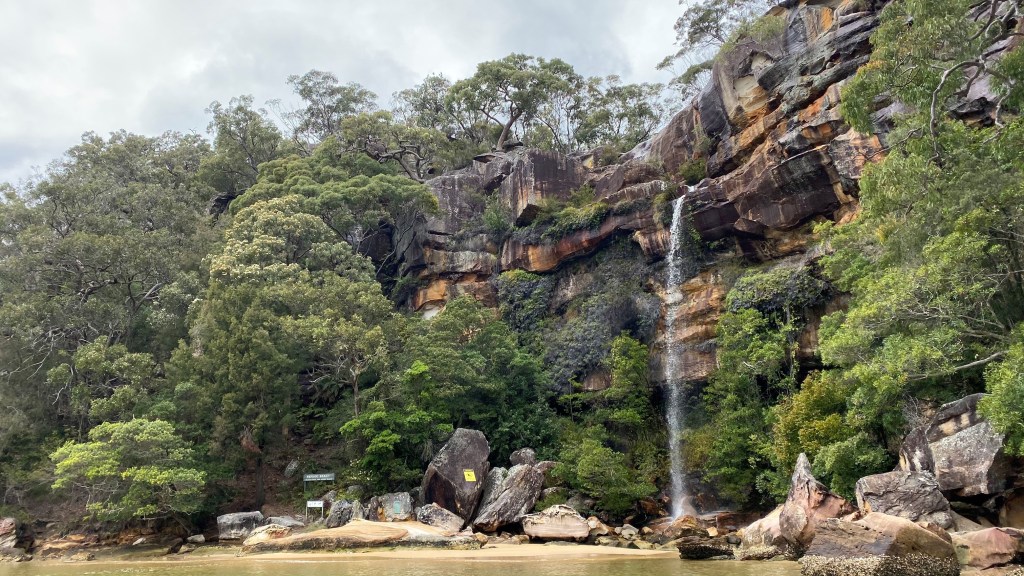
Yesterday was a more challenging than anticipated run-out to America and Refuge Bays in the Ku-ring-Gai Chase National Park, launching from Patonga on the NSW Central Coast.
The weather was beautiful with clear skies and a warm sun, with a perfect paddling weather temperature topping off at 27° C, but the previous day’s forecast of almost no wind was a little misleading.
Launching at 7.30am from the Patonga Boat Ramp tucked away in Dark Corner, from the off we had a gentle breeze which quickly built to a moderate breeze. Sustained 15 knot westerly winds would cut across our bows once we headed south, and would bring up some choppy, white horses.
Trip plan details
- Group size – 2
- Distance – 26 km
- Duration – 7 hrs
- Weather – sunny, 28°C, light breeze (1-4 kts)
We initially cut across from Patonga to Flint and Steel beach, then tracked south west following the shoreline all the way into and around America Bay and Refuge Bay. Not surprisingly the beach at Refuge Bay, under the waterfall, was pretty busy, mainly with jet-skiers, and kids from the many moored boats in the bay. We were fortunate to find a small sandy strip just at the eastern end of Refuge Bay, by the small creek mouth, free of people and with space enough to pull up our two Mirage 582s – and facing into the sunshine, too!
After a swim in the shallow and warm waters of the bay, we sat for an hour or so with an early lunch and several cups of tea, watching the tide slowly drop the water level and leave our craft high up on the shore, and taking in the beautiful scenery.
With 13 km done, it would be another 12 km back, this time tracking across from Refuge Bay towards Fisherman’s Beach, then along the eastern shoreline to the Hawkesbury Channel, across to Little Patonga Beach, and then back to the launch point.
Crossing the channel here was the trickiest part of the day, with strong westerly gusts bearing almost headlong at us, grabbing the paddle blades in the air between strokes, slowing us down and seemingly trying to off-balance us. Sticking close together in case of a capsize, we made it across without incident, into the lee of the coastline, just a little further up the coastline from a busy Fisherman’s Beach. (It was reassuring to see a passing Maritime Rescue boat at this time – good to know those guys are out there!)
Turning northeast and heading for home, we pretty much had a chasing wind and following sea. Timing the run back with a dropping tide gave us a speedy run across the mouth of the Hawkesbury, with a clearly visible brown silt flow highlighting the Hawkesbury’s contribution to the massive volume of water heading out to sea.
Once into the bay off Little Patonga Beach, it was a peaceful track around the shoreline, the smallest and most gentle of waves lapping the shore of the sweeping, deserted beach.
Once again, rounding the final headland we had strong westerly gusts chasing our backs, and we opted for a straight run back to the boat ramp rather than tracking around the shore (and the quirky patch of surf at the mouth of Patonga Creek).

All told, it was 24 km over about six hours, plus an hour for lunch. Not a fast run by any means, but speed wasn’t the objective. I was itching to get out on Broken Bay, and my paddle partner was looking to gently ease back into the saddle having been away from enclosed sea areas for sometime.
We had a plan (literally and figuratively), we stuck to our plan, and we got back safe and without issue having had a beautiful summer Saturday out on the water!
 Get Kayaking on the Central Coast