So this weekend I got to run my first two kayak instruction sessions for my local kayak retailer and services supplier, Kayak Central Coast.
On Saturday I delivered the Paddle Australia (PA) Basic Skills course to six participants on sit-on-top kayaks (SoTs), which included some Viking Espris and a couple of Mirage craft (a Freeride 533 and 583).

It was fitting that my first session was for SoTs given my first kayak was an Espri.
And better still, it’d been over a year since I’d last been on one, and boy, I’d forgotten how nimble these craft are!
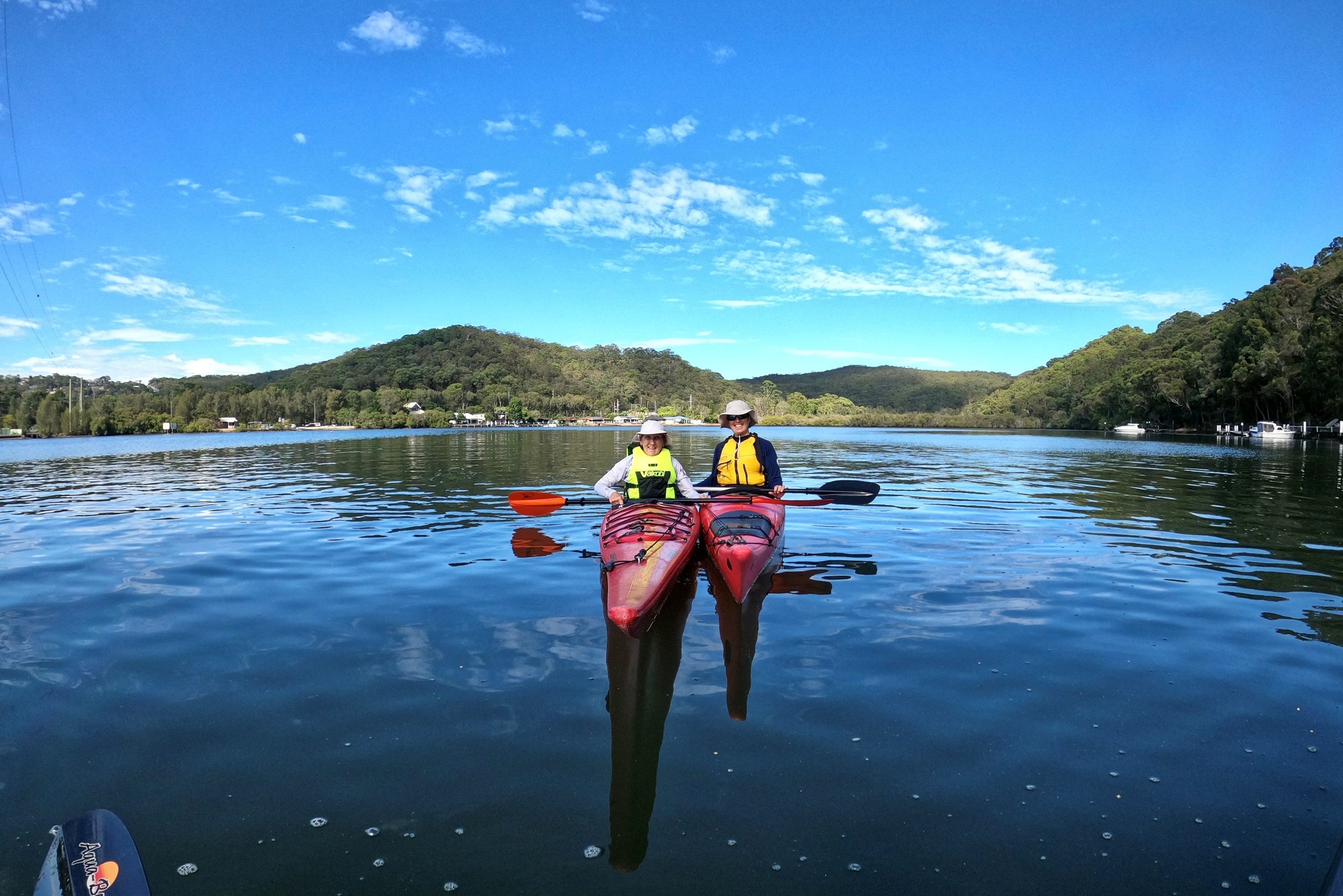
We were also treated to near-perfect conditions, with the wind picking-up only towards the end of the ‘paddle strokes’ section of the course, so only mildly impacting the group’s practicing of the ‘side draw’ – and certainly not preventing the group raft-up and obligatory photo!
With the paddle strokes out of the way, we then got stuck into the ‘managing a capsize’ activities with the group working through ‘capsize and wet exit’; swimming with their kayak and paddle; accepting a tow from a rescuer (grabbing onto the rear of the rescuer’s kayak); abandoning their kayak and accepting a ‘deck carry’; and then finishing-up with an assisted deep water re-entry, ending-up back in their kayak.
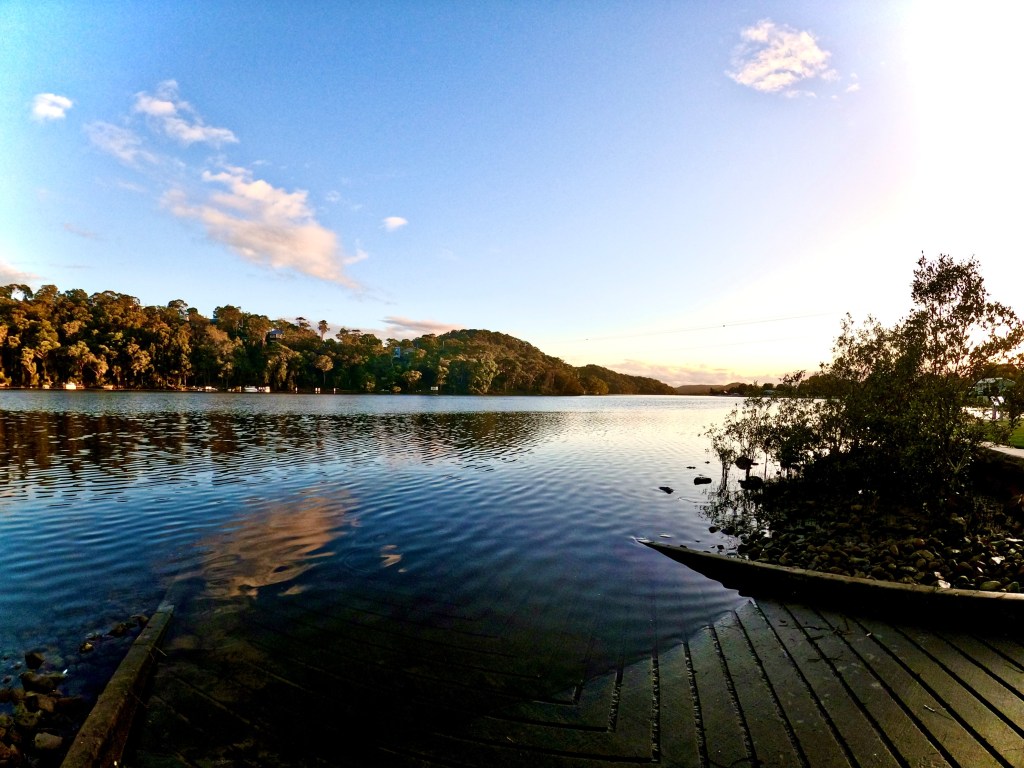
And that’s where the beautiful waters of the NSW Central Coast come into their own and make this area a perfect place to learn and practice kayaking skills. Air temperatures in the low 30s (°C) and water temperatures of 22 making taking a dunking almost a pleasure!
With each participant successfully completing these rescue exercises, that concluded the on-water work and it was back to shore for a post-session recap, which included sharing feedback with each of the participants – along with little things each of them could work on next time they’re out on the water – and some discussion on possible next steps, such as practice paddle trips and further instruction.
Smiles all-round, from both the participants and the instructor!
Sunday, the following day saw two additional participants take on the challenge of the PA Basic Skills course, this time in sea kayaks. Although a little overkill for the perfectly flat waters of the Woy Woy Bays, these sit-in kayaks add a range of additional skills challenges in comparison to SOTs:
- their increased length over typical recreational SoTs – adding anything up to an extra 2m in length – makes them quite a bit less manoeuvrable, although provides improved tracking in a straight line
- typically having a rudder for maintaining tracking, particularly in strong currents or winds, means rudder pedals/foot pegs need setting-up correctly and their operation requires additional instruction
- often being much narrower in cross-section, and with a ‘softer’ chine (i.e. a more rounded and/or ‘V-like’ shape, rather than a boxy shape with flatter hull), the resulting increased ‘secondary stability’ provided makes these kayaks a little more ‘tippy’ when on the flat
- use of the side draw stroke is all the more important when trying to manoeuvre a longer, sit-in kayak, as time and/or space may not permit sweep stroke-based turns; and of course, it’s the best way to ‘raft up’ for that all important photograph!
- lastly, whereas you fall off a SoT (which pretty much just requires you to clamber back on, ‘belly, bum then boots’ fashion), a sit-in needs emptying of any water and then requires you to somehow climb back in
This all said, the curriculum of the PA courses is such that the necessary skills are fully covered, and with the instruction being delivered to just two participants on the day meant extra time and focus could be spent on any areas found to be challenging.
Much like for the SoT course the previous day, the participants were super-enthusiastic and were able to meet all of the assessment requirements. And with the perfect weather conditions we seized the opportunity to try our hand at self-rescue techniques, both the ‘cowboy scramble‘ and use of the paddle float.
Now, unless you’re particularly experienced, my view is that you should always paddle with a partner (or as part of a group). Should you find yourself in some form of difficulty, you’ll have immediate assistance on hand. And even if your paddle colleagues haven’t themselves been trained in assisted-rescue techniques, and its you in the unfortunate circumstance of a capsize, you can provide the necessary direction to them to assist you back into your kayak.
However, being able to recover from a capsize under your own steam is a great advantage, and it was great to see that one participant was successfully able to get back into their kayak using one of the methods, and the other candidate likewise, using the other method.
Both assisted- and self-rescue techniques become a bit of a personal thing depending upon the particular kayak you’re using, and the specific features it possesses. For example, is it stable for re-entry or do you need to use a paddle float approach to create the required stability; where on the kayak do you place the paddle when using the paddle float; which deck lines do you grab onto; do you have an electric bilge pump or do you need a manual bilge pump; and where do you store your paddle float and bilge pump? These – and other – considerations all mean that what works best for one kayaker may not be the same as for another, and this needs to be born in mind both learning, and instructing.
So, any formal instruction in kayaking skills and techniques is just the start of the journey with these newly-acquired skills requiring continued work and attention. And whether or not the South African golfer Gary Player did indeed originate the aphorism “The more I practice, the luckier I get.”, the notion holds true in kayaking – and I’ve found the more I practice the more able and confident I become.
 Get Kayaking on the Central Coast