Wet is the answer! Very wet!
In the time it took to confirm to the participants that “Yes, the course is still on”, then leave home and arrive at the venue, the weather took a most unfavourable turn. The end of daylight saving time should have made things a bit lighter at this time of day, but the heavy clouds made it seem a whole lot darker.
Yesterday had been very wet, and the forecast had more than teased that today would just bring showers; so of course, today’s session would be going ahead. Yet half an hour later found all of us huddled together stood next to the boat ramp, debating the pros cons and cons of going out on the water. But as the rain dripped off the brims of our coat hoods and hats we made the unanimous decision to ‘do it!’.
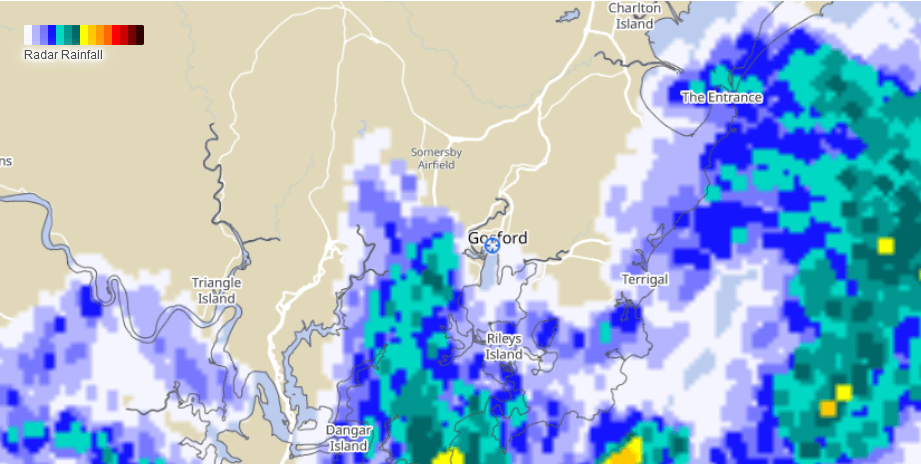
The eager participants were here to learn, and learn they would, happy to ignore the big blue splodge on the weather map just to the east of Riley’s Island, marking out a rain-drenched Woy Woy Bay.
Personally, I quite like kayaking in the rain; it often seems to quiet the wind, and in addition to the sound of rain drops pattering on the water’s surface, I love the absence of the sounds normally produced by other water users, allowing us to enjoy a different kind of peace and quite, devoid of outboard engines and whining jet-skis.
The key to a comfortable paddle in the rain is to get into the kayak warm and dry – a good waterproof jacket and wide-brimmed hat are ‘must haves’ – quickly affix the spraydeck, and then you’re good to go. Also, make sure to adjust the drip rings on the paddle shaft so that you don’t get water droplets running down your arms and soaking the inside of your otherwise dry top – water pooling inside your jacket around your elbows is not a pleasant feeling, especially when you then raise your arm, to side draw for example, and it all then runs down your side. (I find positioning the drip rings on the paddle shaft about midway between your hand and the paddle blade works best.)
That said, however, after 30 mins of off-water instruction held under the insubstantial cover provided by some of the reserve’s trees, it was as though we’d just completed our capsize exercise! Keeping warm would be the challenge for the rest of the morning.
Once on the water, and with no wind and only the gentle falling of the tide to cause our craft any movement, we were able to work through the lesson plan at a good pace. And even with two of the participants new to sit-in kayaks, it wasn’t long before we’d completed the first section and were combining those strokes into a ‘task’.

We next focused on the main turning strokes, the forward sweep and the reverse sweep.
With these strokes it’s essential that in a longer kayak they’re executed effectively to maximise the turn provided through each stroke.
- Maintain usual paddle grip
- Hold paddle shaft low across the kayak, centred off to the side of the kayak (to extend reach)
- Rotate body, keeping the ‘Paddler’s Box’, and make a wide sweeping arc of the paddle from bow to stern (forward sweep) or stern to bow (reverse)
- Use body to push kayak away from the blade
- Look, throughout the stroke, to where you want to travel
- Don’t rush the stroke (to avoid introducing unnecessary forward momentum)
My favourite moment up to this point is where the participants combine a forward sweep with a reverse sweep and find themselves completing a perfect 360° turn virtually on the spot!
To their credit, all of the participants were still up for the ‘managing a capsize’ section of the course – well, we literally couldn’t get an awful lot wetter than we already were!
Working in pairs, each participant rolled their kayak upside down and completed a ‘wet exit’, and after surfacing and becoming the ‘victim’, retrieved their paddle and swam to the front of the kayak. Holding the paddle and kayak in one hand, they used their free hand and legs to ‘swim to shore’ and, after a distance, were relieved by their partner (the ‘rescuer’). The rescuer allowed the victim to hitch a tow by holding onto the rear of their kayak. Again after a distance, the victim then abandoned their kayak and practiced a deck-carry on their rescuer’s kayak for a further distance, or hugged the bow of their rescuer’s kayak, ‘koala fashion’. These moves gave each of the participants an understanding of how to get back to shore where practicable, in a fairly simple manner and without the fuss of assisted- or self-rescues, or setting up rope-based tow-lines.
The next task was for the victim to complete an assisted deep water re-entry. This saw their partner assist them in emptying their kayak of water, ‘righting it’, and then keeping a firm hold of it so that the victim could clamber onto the rear deck, swing their legs around into the cockpit, ‘corkscrew’ their body upright, and then position themselves back inside the kayak.
Today was a great example of when/why it pays not to rush this process, but to think carefully about coordinating the body for each step, and taking a brief pause between each step. It’s tiring manoeuvring your kayak around when you’re in the water, and then tiring also heaving yourself out of the water back onto your kayak. And challenging conditions such as we were experiencing add an extra layer of fatigue, plus the cold can sap your energy reserves even further. In short, you don’t have many attempts at this in you, so it pays to focus, and do this right-first-time.
Finally, with all the participants completing this final exercise in good time, all that remained of the session was to head back to shore and some welcome shelter.
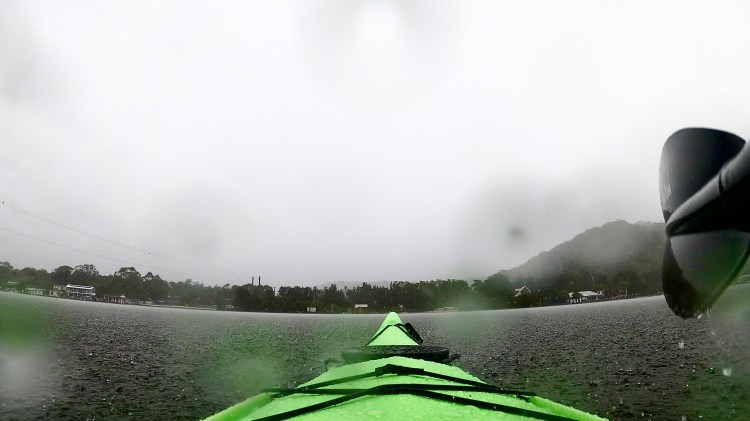
Days like today create a memory, and it’s a great feeling to know that if you can complete your training and learn new skills in weather like this, then you’re well set for paddling safely in a whole range of conditions. Dry clothes, a Thermos of tea and a heated car were not the only rewards of the day.
 Get Kayaking on the Central Coast