The first kayak I owned was a Viking Espri sit-on-top kayak (SoT). I paddled this very capable 3.6m, super-stable SoT for three years, taking it out on many different water types, from the calm Narara Creek, to the open seas between Terrigal Haven and Ettalong; and on progressively longer and longer trips until I maxed-out the range possible in daylight hours. It was soon time to switch-up to something more suitable that combined distance with speed and storage/load-carrying capacity.
In May 2021, some time between the various COVID-19 lockdowns and other restrictions that were in force around that time, I managed to acquire a 5.2m Necky Elaho HV sea kayak – my first experience with a ‘sit-in’ kayak. I found that I could cruise this thing faster than at my top speed on the Espri, and my range was near-doubled. It had two main storage hatches and a ‘day hatch’ just behind the cockpit, and I could carry a whole range of equipment and safety gear with me. And all of a sudden my day-trip expeditions became a whole lot more fun.
The transition from SoT to ‘sit-in’ was not a smooth one for me. At 28kg, the Necky was not a light boat, particularly when loaded with a day’s gear. And, more challenging for me as a newcomer to ‘sit-ins’, it had a soft, ‘multi-chine’ hull (i.e. quite ‘V’ shaped in profile) which meant that whilst it had excellent secondary stability, it’s primary stability I found to be pretty poor – it was constantly ‘tippy’ and I never felt really comfortable paddling it.
That all changed in June 2022 when I swapped-out the Necky for a new Kevlar Mirage 582. At 18kg (unloaded, and minus the electric bilge pump) this was a much lighter craft, and as the hull design is so much better in every respect, I no longer feel like I’m riding an angry steer that wants to buck me off all the time!
For many reasons, though, the Mirage isn’t ideal for delivering flatwater instruction in – not least because it’s both at the higher end of the kayak price range, and instruction and training sessions can include a fair bit of rough and tumble, particularly when the course location doesn’t have a soft sandy shoreline to launch from.
Given I’ve started to spend a lot more time in the education space, I felt that I needed something which I could ‘bang around’ a bit more if needed – and something a little smaller and easier to manhandle, and more manoeuvrable.
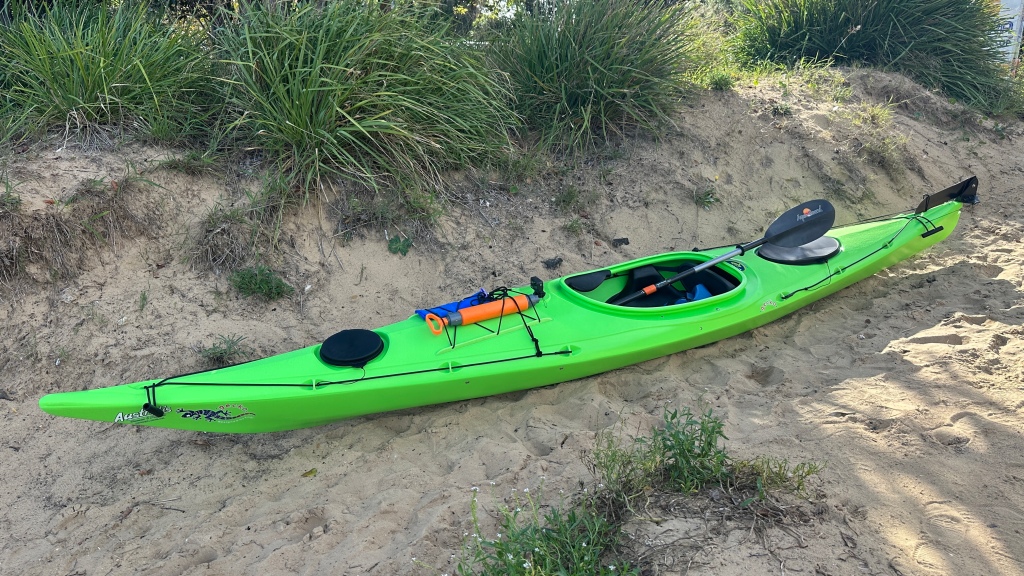
Enter stage-right the Australis Gecko, the smallest in the Australis Lizard Sea Kayak Range.
Features
Visually, the Gecko has I think a really nice form – well proportioned, with smooth curves and lines; sleek, yet functional and practical. It comes in five striking colour schemes: the fluoro-green (which I opted for, pictured), dark blue/white, orange/yellow, red/yellow and yellow. Each of these bright colour schemes is off-set with a colour-coordinated set of Gecko decals.

At 20kg and 4.4m in length, this is a pretty light and easy to manhandle kayak, and I find it really easy to lift unassisted onto my car’s roof bars, and from a storage perspective, poses less of a challenge that my longer Mirage.
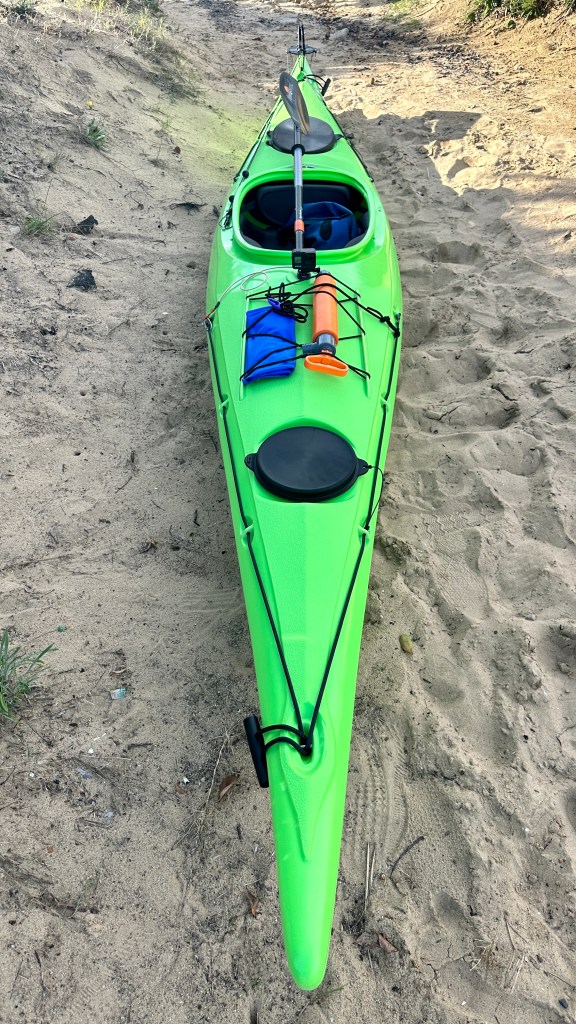
- Length: 4.4m
- Width: 62cm
- Depth: 34cm
- Cockpit: 50 x 86cm
NB: Sea to Summit Flexi-Fit neoprene spraydeck size ‘L’ fits perfectly (not the ‘M’ per Sea to Summit sizing charts!) - Weight: 20kg
- Hatches (sealed by rubber covers): Front – 18cm round, Rear – 41 x 23cm oval
- Dry Storage: Front – 50 litres, Rear – 85 litres.
- Capacity: 140kg (depending on water conditions)
- Decklines front and rear
- Bungee on forward cockpit coaming
- Carry toggles
With bungees across the front deck, I’m able to place essentials like a laminated route map, plus emergency equipment like a paddle float and bilge pump, keeping these items secure yet ready to hand should I need them. There is also a small amount of storage immediately behind the seat back – where I know some paddlers like to keep their paddle float, already partially inflated.
At 62cm wide (compared to my Mirage, at 55.5cm) the Gecko has a wide, spacious cockpit that is easy to get into, even for larger people. For example, I’m 5’10” and 90kg, and with the kayak floating in the water, I can easily straddle it with my legs, drop my bottom into the seat and tuck-in my legs.
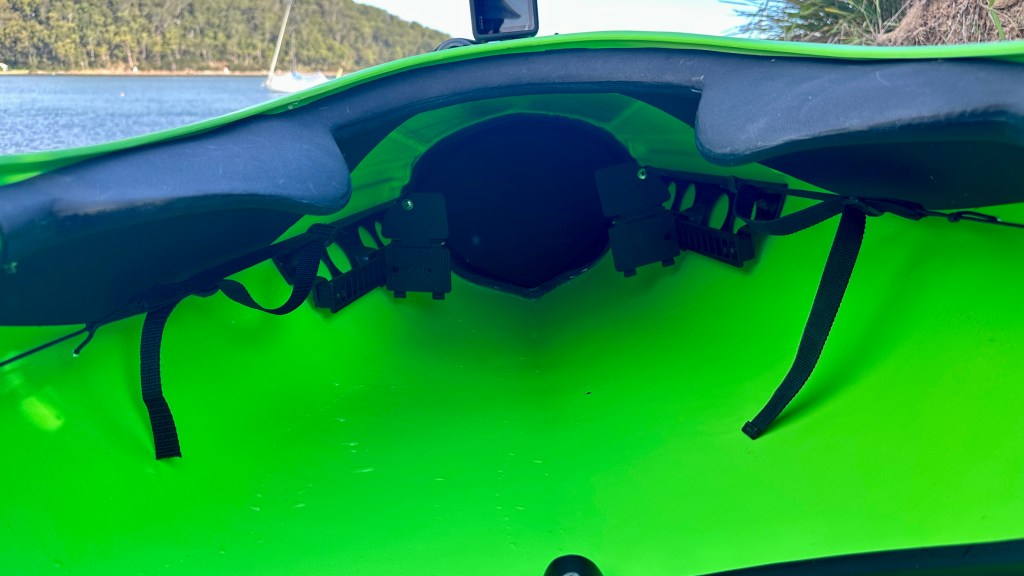
The readily adjustable footpegs which ‘click’ into place on their runners accommodate both taller and shorter people alike, and combined with the thigh braces, allow you to comfortably ‘wedge’ yourself into the seat so your lower body is secured and ‘one’ with the kayak. This arrangement also enables you to generate a good amount of ‘leg drive’ and so put power into each paddle stroke.

The rudder controls are toe-operated ‘flaps’ atop each of the two footpegs, and the rudder cables are easily adjusted even whilst sat inside the kayak. It takes just a matter of minutes to correctly set-up the rudder, and ‘full’ rudder movement can easily be achieved. The rudder itself is lowered and raised into the water with a pulley system that runs along the right side of the kayak, with very accessible controls located at the right hip.
Handling
The outstanding feature of this sea kayak, in my view, is it’s high degree of primary stability, whilst still being able to ride on an edge (secondary stability). Last week I took it out into the surf at a couple of local beaches and it was an immense amount of fun – and I didn’t get rolled once. Combining a tight turn with a solid ‘low brace’ meant I could easily keep the kayak level when turning in a breaking wave, or at the shore after a nice run-in.
Being a shorter kayak, I found it easier to keep a straight track when riding a wave, whereas with my longer (5.5m-5.8m) sea kayaks I find them to be more prone to being turned. And the shorter length also provided more manoeuvrability when on the wave, especially when combined with use of the built-in rudder and application of some ‘stern rudder’ strokes.
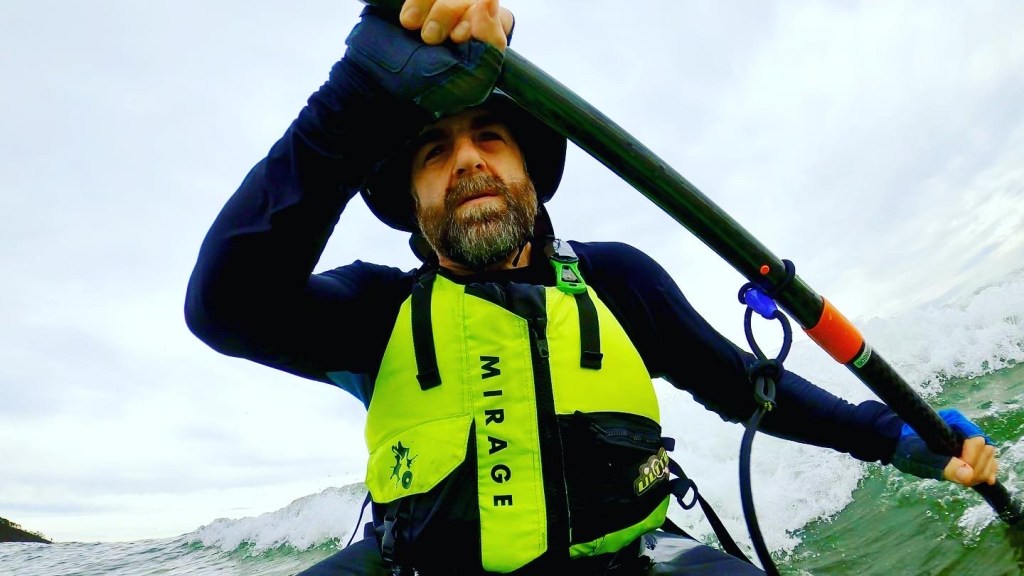
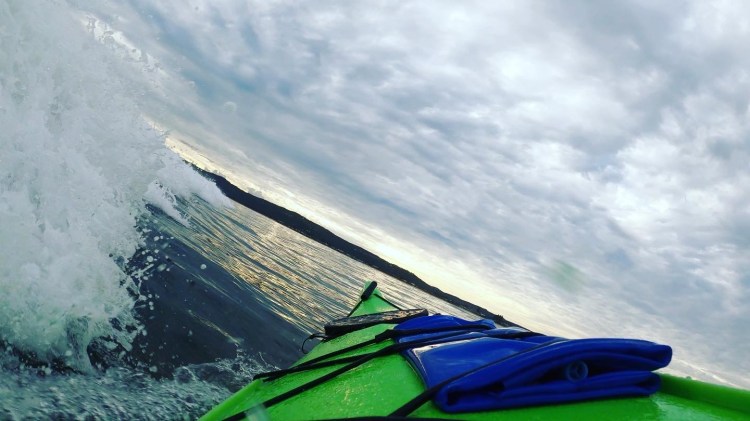
Being shorter – with what I consider a fair amount of ‘rocker’ – means, however, that operation without the rudder requires a little concentration in delivering smooth, consistent strokes on each side, whether moving forwards or in reverse, to maintain a straight track. I confess to being a little on the lazy side and so always use a rudder when one is available.
But this is what creates that manoeuvrability which makes turning this kayak so very easy, perfect for when exploring those narrowing creeks, or when up close to the shoreline and you need to wind your way through rocks and other obstacles. A handful of combination forward-reverse sweeps will see you spin the Gecko 180° (or 360°!) with the greatest of ease!

In summary…
I love the Mirage 582, and it’s absolutely my kayak of choice for longer, touring trips. But from the simple perspective of getting out on the water quickly and care-free, this tough, plastic kayak is my preference. I can bang it around if I need to and drag it up onto beaches (or even complete beach/surf landings) without fear of damage that’s costly and time-consuming to repair.
The Australis Gecko is fully-featured, but everything is simple and easy to operate, and where you need it to be. It’s undoubtedly a fantastic boat for people new to sea kayaks (or ‘sit-ins’), yet a great performer for the more advanced paddler. And although there’s no such thing as an all-rounder kayak, the Gecko will see you right whether it be on flatwater environments, or out in the swell, waves, chop and surf of enclosed and open seas. I can’t recommend this kayak highly enough!
And, finally – it’s Australian-made.
 Get Kayaking on the Central Coast